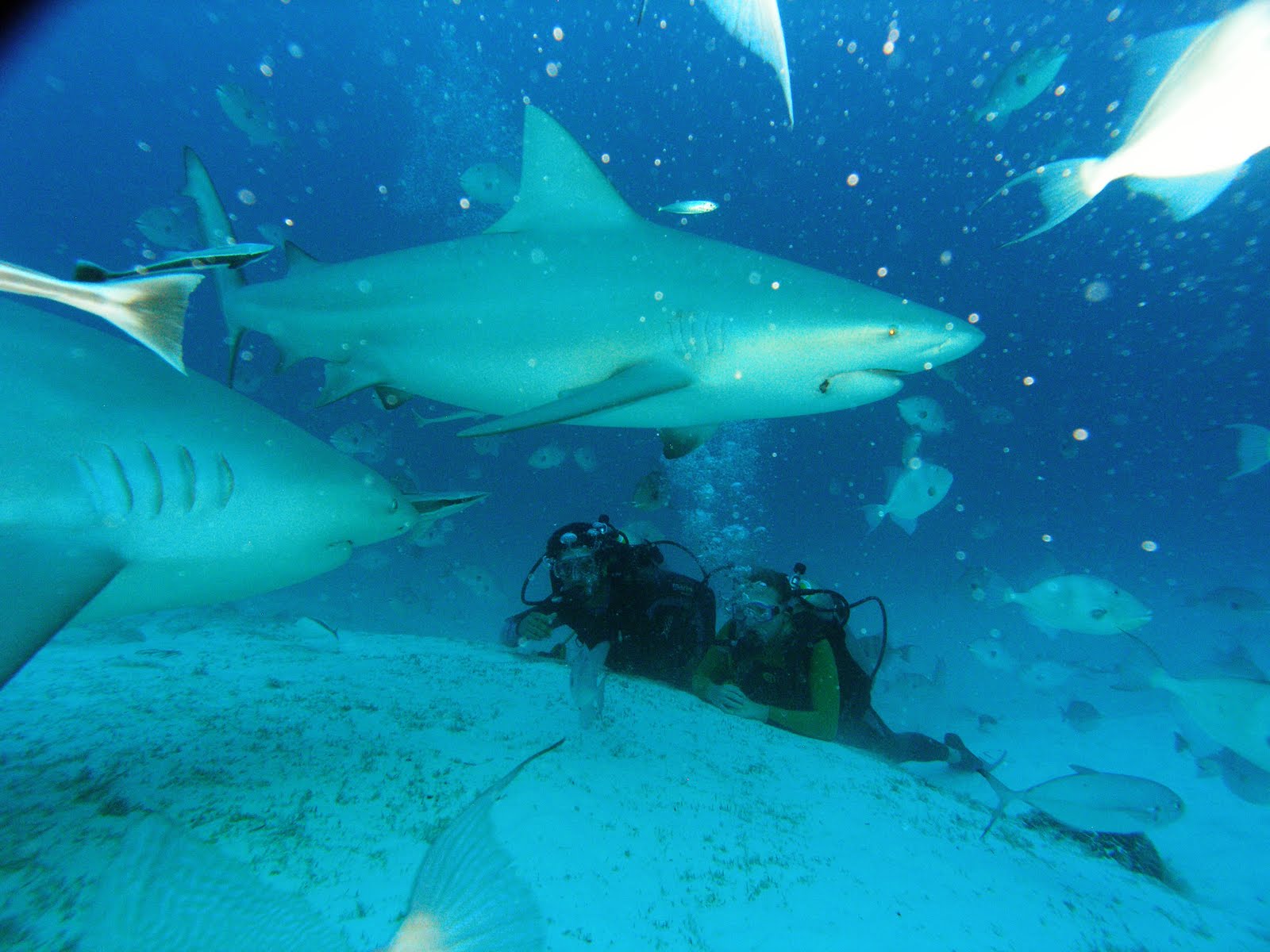
Showing posts with label bull shark dive. Show all posts

Monday, March 12, 2018

WHY ARE SHARKS SO IMPORTANT?


Dear fellow divers, 

As you may already know, many people are still very scared of Sharks, thanks to some famous movies that contributed to their bad reputation. The truth is that they should be more scared of humans, than humans of them. Each year more than 100 million sharks are killed for their fins, and in many countries shark finning is still very common. Shark finning refers to the terrible practice of removing a shark´s fin while the shark is still alive, then the shark is discarded in the ocean again. Unable to swim they are condemned to die slowly of suffocation or eaten by other predators.
For these reasons, nowadays it´s becoming more and more difficult to see a shark while diving.

This is a cruel and wasteful practice that happens daily around the world being a terrible threat to the health of the ocean and the entire marine ecosystem, which is made up of very intricate food webs. Sharks are at the top of these webs; as apex predator they help by removing weak and sick fish as well as keeping the balance with competitors, helping to ensure species diversity.
They are considered to be the “keystone” species, which means that removing them will cause the entire structure´s downfall.


In Playa del Carmen, Phantom Divers collaborates with the association Saving our Sharks (SOS), with the main goal to know and protect our sharks, in order to keep our ocean as healthy as possible and raise awareness for these extremely important creatures. 


The main focus are the lords of the ocean that visit our waters every year and keep attracting tourists and divers from all over the world to the Mayan Riviera: the legendary Bull Sharks. For every dive you book with these magnificent creatures, you are given an orange bracelet representing your support and donation to SOS. So we would like to thank all the people that joined us this awesome season and see you back in November. 


Dive Fun - Dive Safe - Dive Phantom

Tuesday, February 9, 2016

Underwater Comunication

UNDERWATER COMUNICATION


Diving allows an opportunity to be with our own thoughts and provides the peace necessary to stop and appreciate the natural beauty of the world around us.

Part of the underwater world’s charm is its relative silence, the opportunity that it gives us to escape from the incessant ringtones and alarms of life on land. That we can’t communicate as we usually do can also pose problems underwater. Your entry-level scuba course would have taught you basic hand signals to convey important messages underwater signals are the backbone of a recreational diver’s underwater communication, and the longer you dive, the more intricate and elaborate your repertoire will become.

This is a simply overview of some of the most commonly used underwater hand signs. 

The "Okay" Signal
The first hand signal that most scuba divers learn is the "Okay" hand signal. Is made by 
joining the thumb and index fingers to form a loop, and extending the third, fourth, and fifth fingers. This signal can be used as both a question and a response. The "Okay" signal is a "demand-response" signal, meaning that if one diver asks another diver if he is okay, he mustrespond with either an "Okay" signal or the communication that something is wrong. The "Okay" hand signal should not be confused with the "Thumbs-up" signal, which in scuba diving means "end the dive."

The "Not Okay" or "Problem" Signal
Scuba divers communicate a problem by extending a flattened hand and rotating it slowly side to side, similarly to how many people signal "so-so" in a normal conversation. A diver communicating a problem underwater should then point to the source of the problem using his index finger.
The most common use of the "Problem" hand signal is to communicate an ear equalization problem.
The "Up" or "End the Dive" Hand Signal
A "Thumbs-Up" sign in scuba diving communicates "Up" or "End the Dive". This should not be confused with the "Okay" signal. The "Up" signal is one of the most important signals in scuba diving. The Golden Rule of Scuba Diving states that any diver can end the dive at any point for any reason by using the "Up" signal. This important dive safety rule ensures that divers are not forced beyond their comfort level underwater.
The "Down" Hand Signal
The "Thumbs-Down" hand signal communicates "go down" or "descend" underwater. This signal should not be confused with the "not-okay" hand signal used to indicate a problem. The "Down" signal is used in the first step of the Five Point Descent, in which divers agree that they are prepared to begin the descent.
The "Stop" Hand Signal
Divers typically communicate "Stop" in one of two ways. The first method of communicating "Stop" (common in Recreational Diving) is to hold up a flat hand, palm forward, as shown in the left. Technical Divers, however, favor the "Hold" sign, shown on the right, made by extending a fist with the palm-side of the fist facing outwards. The "Hold" sign is a demand response signal; a diver who signals "Hold" to his buddies should receive a "Hold" sign in return, indicating that his buddies have understood the signal and agree to stop and hold their position until otherwise indicated.
The "Level Off" Hand Signal
The "Level Off" hand signal for scuba diving is use to communicate "remain at this depth" or "maintain this depth." The "Level Off" signal is most commonly used to communicate that divers have reached the planned maximum depth for a dive, or to communicate that divers should hold previously designated depth for a safety or decompression stop. The "Level Off" hand signal is made by extending a flattened hand, palm down, and slowly moving it side-to-side horizontally.
The "Buddy Up" or "Stay Together" Hand Signal
A diver places two index fingers side-by-side to indicate "Buddy-Up" or "Stay Together". Scuba diving instructors use this hand signal to remind student divers to stay close to their buddies. Divers also occasionally use this signal to reassign buddy teams underwater. For example, when two divers in a group are low-on-air and ready to ascend, they may communicate "we'll stay together and ascend" using the "Buddy Up" hand signal.
The "Safety Stop" Hand Signal
The "Safety Stop" hand signal is made by holding the "Level Off" signal (a flat hand) over three raised fingers. A diver is indicating "Level Off" for three minutes (signified by the three fingers), which is the minimum recommend time for a safety stop. The safety stop signal should be used on every dive to communicate within the dive team that the divers have reached the pre-determined safety stop depth and agree to maintain that depth for a minimum of three minutes.
The "Low-On-Air" Hand Signal
The "Low-On-Air" hand signal for scuba diving is made by placing a closed fist against the chest. In general, this hand signal is not used to indicate an emergency, but to communicate that a diver has reached the pre-determine tank pressure reserve for his dive. Once a diver communicates that he is "Low-On-Air," he and his buddy should agree to make a slow and controlled ascent to the surface and end the dive by using the "Up" signal.
The "Out-Of-Air" Hand Signal
The "Out-Of-Air" signal is taught to all Open Water Course and Experience Course students so that they know how to react in the unlikely event of an out-of-air emergency. The chances of an out-of air emergency when scuba diving are extremely low when proper Pre-Dive Checks and diving procedures are observed.
Hand signals are generally international, but it’s always wise to make sure you, your buddy and the divemaster are on the same page. Understanding one another is imperative if a dive is to run smoothly, and can make all the difference in an emergency. 

Learn the signals used by local divemasters to describe local wildlife; often the more local animal signals are not universal and you could miss out on an exciting sighting if you don’t know what the divemaster is saying.

And remember to dive fun, dive safe and dive with Phantom Divers.

Monday, October 12, 2009

PROTECT TO THE SHARKS!


Sharks are important to the health of the oceans. Without them, many ocean ecosystems, including several that are vital to the economy, are in danger of collapsing. This collapse would have devastating ecological and economic consequences… and some of these consequences have already started to happen. In addition to providing natural selection pressure and allowing only the fittest to survive by preying upon the weakest, sickest, and smallest fish, sharks are also important to marine ecosystems in other ways.
Human beings are better off with sharks than we are without sharks, and we are in danger of losing them forever… but you can help! Learn all you can about sharks, their ecological and economic importance, and the threats they face. Pass on what you have learned to others.The more people that know about this, the better off sharks will be!

MORE INFO: INFO@PHANTOMDIVERS.COM

Thursday, October 1, 2009

UPcoming events....


From November to february bull sharks runs in the Mexican Caribbean.
Bull sharks are large and stout. Males can reach 2.1 m (6 ft 11 in) and weigh 91 kg (200 lb). Females can be much larger: up to 4 m (13 ft 1 in)[13] and 318 kg (700 lb). Bull sharks are wider than other requiem sharks of comparable length, and are grey on top and white below. The second dorsal fin is smaller than the first.

Bull sharks breed in the summer, often in the brackish water of river mouths. After gestating for about a year, a bull shark may give birth to as many as 13 live young (they are viviparous). The young are about 70 cm (28 in) at birth and take 10 years to reach maturity.

This season is gonna be AWESOME!

Sig in now at: info@PHANTOMDIVERS.com

Wednesday, September 23, 2009

HANGING OUT with BULL SHARKS...


Sharks have great hearing, and it's usually the sense they employ first when they're on the hunt because sound travels so well underwater. Sharks can start to pick up underwater noises farther away and at lower frequencies than people can, and those wavelengths are just the ones that are often most helpful in the ocean depths. For example, the sounds from swimming usually register in this range.

Next comes scent. Sharks have a renowned talent for sniffing out the tiniest quantities of chemicals in the water surrounding them, but not over extremely vast distances -- they tend to max out at around 450 yards (411 meters). They focus in on an odor by swinging their heads from side to side as they swim, so that their powerful nares can zone in on the source of the smell. Swimming into the current is another common shark strategy -- it's often the direction a scent is arriving from.

LEARN MORE DIVING WITH US!!

info@phantomdivers.com

Tuesday, September 8, 2009

A message from our Customers....


Hi!

Doing well, but a shame to be back at work. Having salt-water withdrawal already. I'm glad that you enjoyed the pictures. As I said, I got a lot more of closeups of the sharks, but figure you have those. I found one more of Charlie in the most dangerous situation of them all ! I forgot to include it before. And thanks for Corrine's email. I just sent her some photos and a note. I'll be posting those notes on the web sites in the next week or two.

Thanks for all your help. I had a lot of fun.

Judy
Yuba city CA.USA

Sunday, September 6, 2009

Bull shark diving... Season 2009-2010 is coming soon!


This year promises to be the best! The Bull shark season 2009-2010 attracts extreme adventure lovers and the gathering will be in PHANTOM DIVERS, located in the Riviera Maya, Mexico.
Make your reservation through internet:

info@PHANTOMDIVERS.com

Do not miss the opportunity to have the best places to watch this beautiful show.
Visit our website:


www.PHANTOMDIVERS.com

Sunday, June 28, 2009

PHANTOM DIVERS AND THE PLEASURES OF PLAYA DEL CARMEN..BY:MORGANATRAVELS


Is Playa Del Carmen the best diving ever? No. But, we've been diving here several times and enjoyed our dives each time. The sites can range from shallow 35' to deep 100+'. The soft corals are in decent shape and there are lots of fish. My personal favorite is the quantity of large turtles that I have seen. This trip was no exception - on one dive we spotted EIGHT turtles, some swimming by, some eating, most within 10' of me! I love to dive Playa because of the turtles!! The excellent vis, pleasant drift (what a wonderfully lazy way to do a dive-lol!), soft corals, lots of fish, lobsters, eels and TURTLES make Playa an area that I enjoy coming back to again & again. We'll be there the end of April for another long weekend of diving.

The capt takes your weightbelt & gear so that you can climb into the boat unencumbered. He switches your gear to a new tank, then before heading to the next site hands out bottled water . The sites are within minutes of the dive shop and the beach is always within visual. This doesn't translate to shore dive & save the boat fare though - keep in mind the reefs are a bit of a swim and with the drift you & your equipment would have quite the walk back! We left around 9am, did 2 dives & were back at the shore around noonish each day . If you are doing multiple days of diving you can leave your equipment at the shop.

Thru the shop you can do Cenotes & Cozumel as well. We have done both in the past. Also, if you are there in the winter months you can do a Bull Shark dive . Our scheduling didn't allow us to particpate, but several diving with us had and loved it.

We've been diving a long time & enjoy a variety of dives. Because of the staff (& I certainly haven't named them all!) at Phantom this deserves an EXCELLENT rating. Again, there are better dives in the world - but, that's certainly no reason to dismis these, that would be the equivalent of avoiding other works by Michelangelo because they aren't the Sistine Chapel!!!! Whether you are a novice or an old jaded diver these are some fun dives and this is a GREAT STAFF!

morganatravels
Kentucky
24 mar 2009

Saturday, May 23, 2009

We are on National TV !!

si el video no se reproduce puedes verlo aquí
">
Ulises Grajales nacional investigator from TV AZTECA aarived to PLaya del Carmen and dove with his friends of PHANTOM DIVERS dive shop located in the Riviera Maya.
Check this video and enjoy it!
Phantom Divers are in everywhere...

Wednesday, April 29, 2009

PUBLISHED ARTICLE ON BAJODELAGUA.COM MAGAZINE, SPAIN.


Hi everybody!
Visit this link about bull shark dive in Playa del Carmen, only with Phantom Divers.
http://www.bajoelagua.com/articulos/reportajes-buceo/buceo-tiburones-bucear-mexico_4608.htm
This article was published on www.bajoelagua.com magazine in april 2009 edition.
Check it out!
For more info:
info@phantomdivers.com

Monday, March 16, 2009

SHARK DIVE ...SO GREAT!


Hi

I am going to be writing really positive comments on both your site and TripAdvisor as soon as I can get to it, because your divemasters and boat captains were terrific, but I at wanted to send a few photos back of our Bull Shark dive on March 5th with Charlie in them, since I'm guessing he's not usually in the photos. I got a good number of what I think are good, clear close-up shots that I'm very pleased with, but I'm sure you have a lot of "shark shots" there. Charlie, the people I work with are impressed with the dive and photos, but tend to think I'm a bit nuts. Thanks for a terrific afternoon.

Thanks for great dives!!

Judy Mikesell
Yuba City, CA